Wednesday, March 18, 2015

Paddy's Day from Bull Island

Seeing that the weather forecast for St. Patrick's Day 2015 was looking favorable, and wanting to avoid the crowds of drunken foreigners in City Centre, we made plans to do something new, adventurous, and outdoorsy for the day. Having already visited so many of Dublin's human-made and natural highlights, we had precious few choices for new outdoor entertainment in the city.

We finally decided on North Bull Island, a small, sandy island on Dublin's north shore. We'd always meant to take a walk on this unique combination nature preserve/golf course/community beach, but it's a bit out of the way. With most of Paddy's Day to spare, we decided a quick ride on the DART to De Nort' Soide and Bull Island would be perfect.


This strange little island formed relatively recently, a consequence of the construction of the north and south walls out of the River Liffey into Dublin Bay. The wallsdesigned by Captain Bligh of Mutiny on the Bounty fame—created a strong tidal pull that helped keep the river mouth from silting and hindering shipping. When the walls were finished, the tide did indeed clean out the river into Dublin's Docklands, but all that silt had to go somewhere, and it ended up piling up just beyond the end of the north wall. The sand and silt pileup soon formed the island that Dubliners know and love today.

Poolbeg Lighthouse from Bull Island

Much of the island today is a set-aside nature preserve for the many species of birds, plants, and mammals that call this unique little stretch of sand and scrub home. The grass is prickly, there are very few trees or woody plants, and the sandy soil rises and falls in rolling dunes throughout the island. This gives it a very alien feel—it's difficult to remember that you're still standing in Dublin City when looking at scenes like this.

Which Planet is This? Dublin's Bull Island
Which Planet is This?

We walked a circuit around the north side of the island, taking the seaward-facing beach one way and following the grassy dunes on the return. The impressive beach, known locally as Dollymount Strand, stretches for more than a mile, and on the hazy day we visited, it was difficult to see either end from the middle.
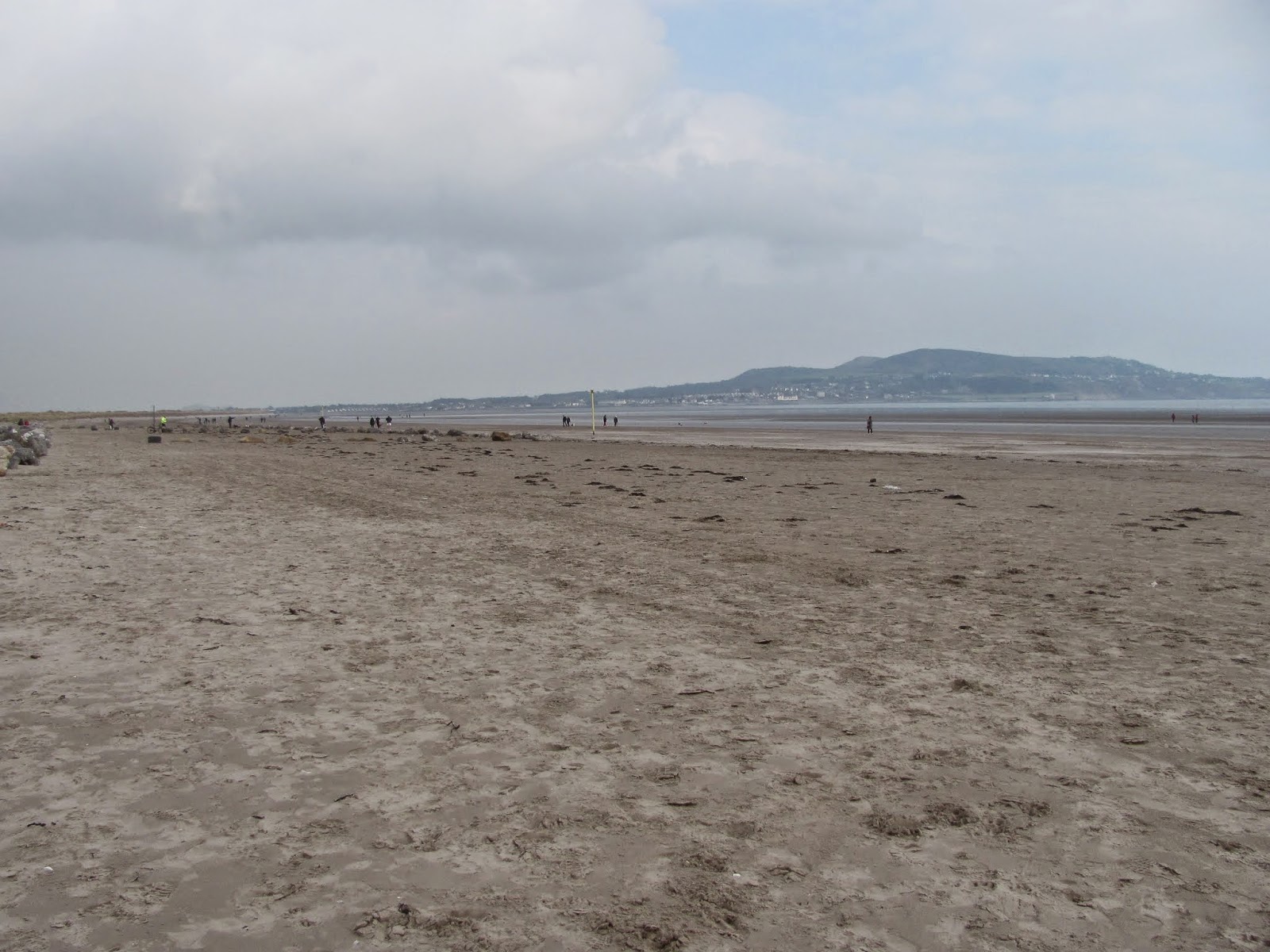
Dollymount Strand on North Bull Island
Dollymount Strand

We've heard this is a popular beach for sunbathing, kite surfing, and learning to drive (?), but on this chilly spring day, it was just a quiet beach with dog-walkers, families, and two Americans getting away from the scrum of the city.

Before heading into the scrubby grass, we asked a local walker if there were any established trails on the island. He laughed as he said, "Go wherever you want! The hares make the trails!"

We quickly saw what he meant, as the rolling dunes of the inner island were crisscrossed with small paths and dotted with rabbit holes.

On the way back, we passed one of the two (!) golf courses on the island. Both of them date back to pre-independence times, so I'll go ahead and blame the English for building (and Irish government gridlock for keeping) golf courses on a nature preserve.

After a nice walk on one of the most unique little habitats in Ireland, we were ready for an American-style St. Patrick's Day meal. I made some marble rye bread, and we assembled reuben sandwiches with some cobbled-together ingredients from the supermarket.

An Irish-American Classic!
A Midwest American Classic!

Yes, that's right, American friends: reuben sandwiches (and their sister dish corned beef & cabbage) are much more American than Irish. Although potatoes and cabbage are indeed staples here, I've yet to meet a corned beef fanatic, and Irish supermarket store shelves are far from heaping with corned beef choices. Want a traditional Irish "salty meat with watery vegetables" meal? Get some unspiced pork sausage, unsmoked bacon, cabbage, and potatoes and make Dublin coddle, a classic enjoyed all over Ireland... for some reason.

Hope everyone had a happy and safe holiday!

Monday, March 16, 2015

St. Patrick's Day Treasure Hunt 2015

Even though we'll be ducking out of town for the melee that is Paddy's Day in downtown Dublin this year, we couldn't miss out on what was our favorite St. Patrick's Festival activity last year: the annual treasure hunt.

Festival Treasure Hunt 2014

With free admission to several normally pricey Dublin attractions and a free goodie bag, who could say no? On Saturday morning, we were primed and ready.


We didn't know the route for this year's hunt until we showed up at Trinity to register. Much to our surprise (and delight!) there were several stops that we had yet to visit for one reason or another. Ok, let's be frank, the reason was money.

We made a point to don our cheap headgear for a photo stop at each checkpoint on the hunt. First up, the Lurgan Longboat at the National Museum: Archaeology. We knew exactly where this hard-to-miss exhibit was on display. It spans the whole width of the ground floor gallery, after all.

Lurgan Longboat—National Museum: Archaeology

Just around the corner, we had to check out a huge tapestry in the main atrium of the National Gallery, Ireland's fine (and free to visit!) collection of art by Irish and European masters.

Atrium Mural—National Gallery

Fighting through the crowds of hungover partiers out for some hair of the dog, we took a lesser-known route to the northside to count the number of antique wooden post boxes at Ireland's General Post Office, where the Irish Proclamation (their Declaration of Independence) was first shouted by Patrick Pearse back in 1916.

Wooden Post Box—General Post Office

Then it was on to D8, Dublin's Viking Quarter and Liberties. We had to stop at Christ Church Cathedral, and here we slowed down our pace. Christ Church charges admission—a strongly-encouraged donation, technically—to its sanctuary. Therefore, neither Sara nor I had ever actually set foot inside the main church. We flashed our treasure hunt sheet at the ticket-takers and strolled right on in. After finding our target (the tomb of Norman leader Strongbow, now the namesake of a popular brand of hard apple cider), we took our time exploring the rest of the sanctuary and the museum in the underground crypt. I simply couldn't miss a chance to see the church's most famous post-life residents (maybe even more famous than Strongbow), the mummified cat and rat discovered in an old organ pipe.

Strongbow's Tomb—Christ Church Cathedral

Mummified Cat and Rat—Christ Church Cathedral

Down the hill from Christ Church, we also had to visit St. Patrick's Cathedral, also a former Catholic church seized (and never returned) by the Church of England during the Reformation. It is also another church that, ahem, asks for a financial consideration for entry. Again, we bypassed the long ticket line and strolled right in.

Cory and Sara at St. Patrick's Cathedral
St. Patrick's Cathedral

Around the corner from St. Patrick's is Marsh's Library. I'd seen it on maps, but knew very little about it, except that it normally charges admission for entry. Not so today! Inside, it's a bit like a Trinity-Long-Room-Lite. Shelves of important-looking leatherbound books stretch from floor to ceiling. Yer Man himself, James Joyce, used to read and study among the books and busts of this small library. No photos allowed inside, so we posed at the door.

Marsh's Library, Dublin
Marsh's Library

Our last stop was at the National Archives. We were a bit tired, so we didn't hang around to look at the rest of the documents on display.

National Archives — Dublin, Ireland
National Archives

Our sheet stamped and our stomachs ready for lunch, we returned our completed treasure hunt sheet, got our timestamp (probably not breaking any records), and enjoyed some of the finest tourist watching in Europe while we ate our picnic lunch and admired the goodies in our gift bag.

Happy St. Patrick's Day! Wherever you are, celebrate safely.

Tuesday, March 10, 2015

Dublin's Dual-Edged Relationship with St. Patrick's Day

It's St. Paddy's week, and throughout the world, people are getting ready to celebrate the feast day of the English-born, Irish-made Catholic Saint Patrick. The epicenter of all this sudden holiness is right here in Dublin. Just as you'd expect, the locals are gearing up for the party getting the hell out of town.

Irish Tricolor Banners Going up in Dublin 2015
Irish Tricolor Banners Going up in Dublin

Even the politicians don't want to hang around as the city braces for the biggest tourist (and cash) influx of the year. Going around town the last few days, I've already seen the party ramping up. Leprechaun beards, buckled green hats, and kitschy novelty souvenirs are hanging in many shop windows and from half-drunk humans in and around City Centre.

Dublin's relationship with the annual melee is two-sided: they graciously embrace and welcome the international tourists (and their money) to the city true to the famous Irish reputation for hospitality, but loath the noise they make and the mess they leave in their wake.

In an age where binge drinking is being recognized as a major health hazard rather than harmless, youthful fun, Dublin on St. Patrick's Day remains one of the last bastions of debauchery, rivaling Mardi Gras in New Orleans and Carnival in Rio, especially in Temple Bar after the parade.

St. Patrick's Day 2014—Dublin, Ireland
St. Patrick's Day 2014

Some here argue that the festivities should be toned down—and binge drinking strongly discouraged—but for now, money seems to speak louder, as Dublin battens down the hatches for another coming storm.

But not everything about Ireland's national celebration is dark and dangerous! The city council always puts on a great program of (mostly free) events beginning a few days before the St. Pocalypse. This year, the family-friendly Paddy Party kicks off on Saturday, March 14.

We'll be around for some of the free activities in the city, but on the Day of Green-ening, we have some special plans—out of town, just like true Dubliners! Wherever you are, celebrate safely!

Sunday, March 8, 2015

2015 Five Lamps Arts Festival

—Cross-post from Five Suitcases


In Dublin this week? Check out the Five Lamps Arts Festival, with daily events until March 14th—many of them free. Music, theater, dance, and even a free train ride to Sligo are all on the docket for this year's festival.

We followed along Dublin historian Pat Liddy for a very well-attended guided tour of the northside Docklands and Liffey bank. The tour was a team effort of the Five Lamps Festival and Dublin City Council's Let's Walk and Talk (check it out, lots of great, free walks every week) program.

Samuel Beckett Bridge at High Tide Dublin, Ireland
Samuel Beckett Bridge at High Tide

Dublin's Docklands have been a story of boom and bust since before the days of the Celtic Tiger and the Crash of 2008, although they certainly bear the scars of this most recent round of development and disaster.

To combat the wildly-fluctuating tidal river level, a series of inner docks was built on both sides of the river to ease loading and unloading of cargo along Dublin's Liffey banks. As time progressed, and cargo began coming to Dublin in massive container ships docking closer to the sea, the inner docks were open to development by the railroads, housing schemes, and, during the recent Tiger years, speculative office and retail space construction. Today, the now-sought-after apartments and the empty shells of the never-filled bank and insurance buildings are all that remain in much of these once-bustling inner docks.

Docklands Apartments Dublin, Ireland
Docklands Apartments

To monitor all this trade, particularly the highly-taxed goods like alcohol and tobacco, trade authorities constructed the Customs House and the nearby warehouse, now called Custom House Quay to hold, count, and collect taxes on these specially-regulated materials. Today, Custom House Quay (called simply, "CHQ") houses a mostly-empty block of retail spaces, but at one time it stored tons of tobacco and barrels of whiskey waiting for duties to be paid for release. Its characteristic iron-and-glass ceiling was copied all over Continental Europe for train stations, many of which were destroyed in World War II bombings.

Custom House Quay Iron Ceiling Dublin, Ireland
Custom House Quay Iron Ceiling

Of course, cargo wasn't the only material shipped in and out of Dublin's once-busy urban Docklands. During the Famine, desperate emigrants piled to Ireland's ports by the thousands hoping for a chance at a better life in England, Australia, or North America. A replica of one of these passenger ships, the Jeanie Johnston, is open as a museum—a look at what the living conditions were like for the weeks-long Atlantic passage.

Jeanie Johnston Tall Ship Museum Dublin, Ireland
Jeanie Johnston Tall Ship Museum

Riverside Famine Memorial Dublin, Ireland
Riverside Famine Memorial

As a memorial to this black spot in Irish history, a thoughtful memorial—depicting real people—stands near the dock from which so many embarked on their journey to a new life across the sea. Interestingly, a similar series of statues stands in Toronto, Canada. All of the people depicted in this memorial (except the dead child being carried) made it safely to Canada and thrived in North America.

After the walk, I was inspired to flesh out my Riverside Walk in The Frugal Guide book and make it the next audio tour in the podcast series. Having learned more interesting factoids about the Famine Memorial, and that CHQ has free toilets, I feel it my duty to make this a proper tour. Look for the book update and audio tour in the coming weeks.

Now that the Irish spring has fully sprung, keep checking the Dublin Event Guide for more and more free festivals and goings-on. The weather is getting warmer, the Irish are coming out of hibernation, and the tourists are once again flooding City Centre. It's a great time of year to be in Dublin.

...And don't forget that St. Patrick's Day is coming up here in the ancestral home of the Shamrock Shake. 

Thursday, March 5, 2015

Mary Gibbons Newgrange Tour

Yesterday, I had the pleasure of joining local historian and well-known tour guide Mary Gibbons for her famous tour of the Hill of Tara and Newgrange via Navan, Slane, and the rest of the Boyne Valley.

After our public-transport adventure to Newgrange last year, I was happy to be revisiting the site on a carefree, well-paced tour with a knowledgeable guide. A stop on the famous (but imagination-requiring) Hill of Tara was just a nice bonus.

The tour picked up at a few City Centre hotels while the guide pointed out historical Dublin points of interest—some of which were even new to me! It felt good to be a tourist in my adopted hometown again.

As we left Dublin and entered the hinterlands of County Meath (Dublin's western neighbor), Ms. Gibbons shared her expertise on the last several thousand years of Irish history with a multinational crowd on the tour bus—I told you I felt like a tourist again!

Hill of Tara


The first stop was the famou Hill of Tara. Imagination is required because there are very few physical remains of the simple structures that would have stood on this scenic hilltop centuries ago. Today, it's mostly mounds covering old foundations and a few small monuments. The rolling slopes would make this a challenging pitch and putt golf course, but archaeologists have wisely decided to preserve it as a pleasant, windswept hilltop of history with a 360 degree view of Eastern Ireland.

Hill of Tara Monument Co. Meath, Ireland
Hill of Tara Monument

Hill of Tara, Co. Meath, Ireland
Take a Penalty Stroke

The Hill of Tara was an important strategic and symbolic place for ancient people in Ireland, the High Kings of this part of the country were crowned here, and the gods of life and fertility may have been appeased with offerings and sacrifices.

Now that I've seen it, I need to go back to the National Museum and look at the Tara display there. They have on display a large, 3D model and extensive coverage of the archaeological excavation of the site. Because so little remains, it is difficult to visualize while standing on the hill itself. Without a knowledgeable guide, a visit here would be little more than a nice look at the midlands of Ireland.

Newgrange


The real star of the tour is, of course, Newgrange. This ancient (older than the pyramids) structure is one of the oldest and best-preserved human-made "buildings" in the world. Even though I've visited this monument before, I was excited to see it again.

Access to these ancient structures is by guided tour only, and the tours leave from the Brú na Bóinne Visitors Center on the banks of the beautiful River Boyne. On my last visit, the river was swollen from rain and melting snow on the hilltops.

The Beautiful River Boyne Co. Meath, Ireland
The Beautiful River Boyne

Very briefly, Newgrange is one of several astronomically-aligned structures in this river valley—and one of hundreds or thousands in Western Europe. A narrow passage enters a huge, human-made earthen mound, ending in a small chamber. The passage entrance aligns with the rising sun during the winter solstice, and a specially-designed window-like opening above the door allows a beam of morning sunlight to penetrate down the passage to illuminate the inner chamber for just a few minutes during the midwinter sunrise. 

Newgrange Entrance Co. Meath, Ireland
Newgrange Entrance


The stone age engineering of the structure and the swirly, spiralling carvings are really a sight to behold. The interior tour is meaningful and it ends with a simulated winter solstice sunrise effect, recreated with an electric light.

No photos are allowed within the passages of Newgrange, so if you're curious, get over here and tour it yourself!

Passers-By


Between the Hill of Tara and Newgrange, the tour passes through the village of Slane (and its famous castle) and near the site of the seventeenth-century Battle of the Boyne, the result of which is still sharply felt in Ireland and Northern Ireland today. None of these are really worth a look outside the bus—particularly the battle site, which is now just farmland—so the tour passes through, points out, explains the interesting details, and moves on. 

In my opinion, this is a great choice to keep the tour well paced yet interesting and informative. A little time on the bus, a little time outside, a little time on the bus, etc.

Big thanks to Mary and Newgrange Tours for a great tour. I'll be adding a longer review of the tour (and a few new historical details!) to the next update of The Frugal Guide: Dublin. Even though this day out isn't free (I'd love to see that day trip!) it's a great value, speaking as someone who has fought the battle of Newgrange via public transport. I've you've got a day to spare in Dublin, drop Mary a line and tell her I sent you!